• About

Golf Science Guru

~ Simple Science to Improve Golf

Golf Science Guru

Tag Archives: Putting

Relative Importance of Putter Stroke Path versus Putter Face Squareness at Impact (Part 3 of 3)

24 Wednesday Jun 2015

Posted by golfscienceguru in Golf

≈ 1 Comment

Tags

Putting

(Continued from Part 2)

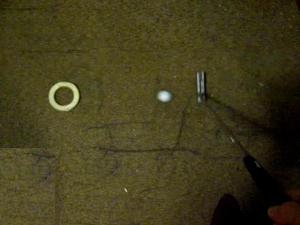
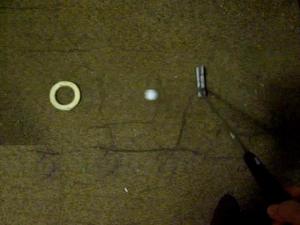
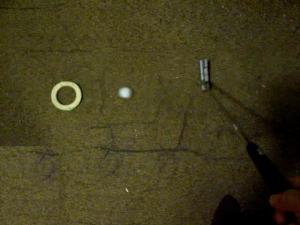
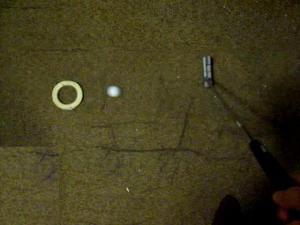
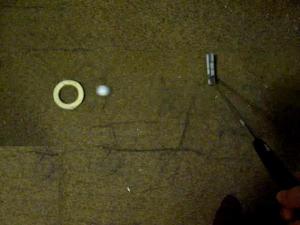
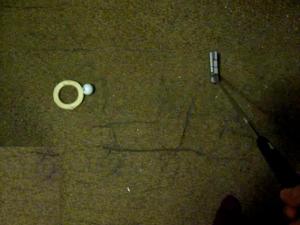
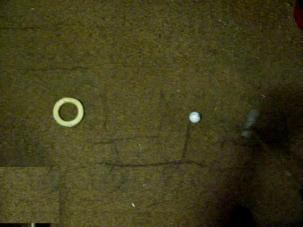
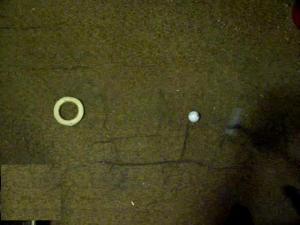
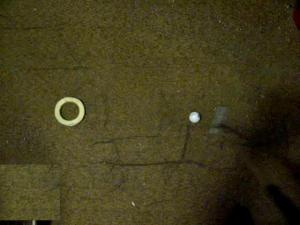
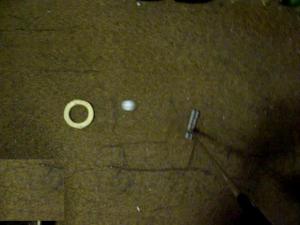
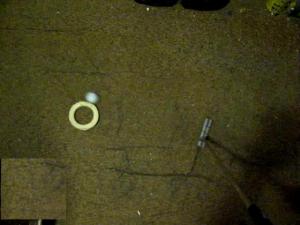
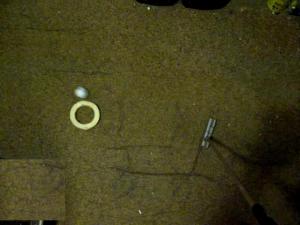
It can be seen that a squared putter face at the moment of impact with the golf ball is of much more importance versus the path of the putter, as it seems that the path of the putter head is of little importance, as seen in Experiment #1 and #2.

In Experiment #1, the putter head path was good, but the putt missed because the putter face was off and not squared at impact.  The ball basically took off in the direction where the putter face was pointing.

A good stroke path cannot fix a bad face angle.

In Experiment #2, the putter path was way off about 40 degrees to the right of the target line, but the putt was made because the putter face was squared at impact.

A good and squared putter face at impact can fix a bad putter stroke path.

The precise ratio of importance between clubface angle and clubhead path will be discussed later, as the ratio is different depending of the club from putter to the driver.  For the putter, the ratio can be taken as 90 to 95 percent important for face angle versus only 5 to 10 percent important for the putter head stroke path.  For the driver, the average ratio is 70 percent important for face angle versus 30 percent important for the driver swing path for an advanced player.  (For the big slicer, driver swing path becomes up to 90 percent important versus driver face angle.)

A lot of work to get the putter face as squared as possible at ball impact to the start of the target line can increase the making of medium and long putts.

One method is the use of guide lines on the ball to help making putts.  In the old days, the ball-name label imprinted on the ball can be used as the putting guide line.  Now, a long line is drawn around the ball to serve as a long putting guide line, as seen on television broadcasts of PGA golf tournaments.  Most times, the guide line, or ball-name label is set inline with the starting part of the target line.


pg1a

Figure 3-1.

Figure 3-1 shows the ball-name label set inline with the initial part of the target line, so as to served as a guide line for the putting stroke.  For a flat and straight putt, the ball-name guide line serves to point in the direction of the hole.

Less seen is to place the ball with the ball-name label squared to the start of the target line, as shown in Figure 3-2 below:

pg2a

Figure 3-2. 

In Figure 3-2 the ball-name label is set squared to the starting part of the target line. This set up of the ball-name guide line is to encourage returning the putter face to the same squareness as the ball-name at the moment of ball impact.

Because squareness of putter face at impact is ninety percent or more of importance, logic implies that the ball guide line be set squared to the target line as in Figure 3-2 for over ninety percent of putting practice to improve the squareness of clubface at impact with ten percent of practice with the ball-name label, or drawn guide line on the ball set inline with the target line to improve the stroke path.

From a previous blog, the theoretical allowable deviation of putter face from square at impact is calculated as the arctangent of golf hole radius divided by the length of the putt.  For a short straight putt on flat and smooth surface, the putter face is to be no more than one degree off at impact.  For a medium putt, less than half a degree deviation from square is allowed for making the putt.  For long putts, less than one-third degree of deviation from square at impact is allowed.  For very long putts, deviations of less than one-tenth, one-hundredth, and so forth may be called for, although it is probably beyond achievable to consistently maintain deviations from square to such tiny fractions of a degree.  These precision is in the realm of surgeons who can cut off a single layer of cell tissues.

The are many systems to get the putter face as squared as possible at impact.  Whole books may be written on this single topic.  There is even mathematics that can be used to putt in “hyper-space” where in sci-fi movies, long distances of many light years can traveled as short distances in hyper-space.  Putting in hyper-space can make 30 or more feet putts almost as easy as a two feet putt.

While putter stroke path is of much less importance, it can still decide whether a long putt is made or not.  Here too many articles and books are available for increasing the precision of the putting stroke.

Before delving further into this topic, judging and controlling putting distance will be discussed in the next blogs.
Relative Importance of Putter Stroke Path versus Putter Face Squareness at Impact (Part 2 of 3)

24 Wednesday Jun 2015

Posted by golfscienceguru in Golf

≈ Leave a comment

Tags

Putting

(Continued from Part 1)

Experiment #2 – Putter Path Off, while Putter Face Good.

While the putter path is way off, the putter face angle is good and squared at impact, and the putt is made.


PuttPathOff00100

Figure 2-1.


PuttPathOff00200

Figure 2-2.


PuttPathOff00300

Figure 2-3.


PuttPathOff00400

Figure 2-4.


PuttPathOff00500

Figure 2-5.


PuttPathOff00600

Figure 2-6.


PuttPathOff00700

Figure 2-7.


PuttPathOff00800

Figure 2-8.


PuttPathOff00900

Figure 2-9.


PuttPathOff01000

Figure 2-10.


PuttPathOff01100

Figure 2-11.


PuttPathOff01200

Figure 2-12.

Although the putter stroke path is almost forty-five degrees to the right of the hole, the putt was made, when the putter face was squared at the moment of impact with the ball.


(Continued in Part 3 …)

Relative Importance of Putter Stroke Path versus Putter Face Squareness at Impact (Part 1 of 3)

23 Tuesday Jun 2015

Posted by golfscienceguru in Golf

≈ Leave a comment

Tags

Putting

The relative importance of putter path versus putter face angle can be seem from the below two experiments.  In the first experiment, the putter stroke path is straight towards the hole, while the putter face angle is off from being squared at impact.  In the second experiment, which is shown in Part 2, the putter stroke path is way off from the hole, while the putter face angle is kept squared at impact.

Experiment #1 – Putter Path Good while Putter Face Off.

PuttFaceOff00200Figure 1-1.

PuttFaceOff00300

Figure 1-2.

PuttFaceOff00400

Figure 1-3.

PuttFaceOff00500

Figure 1-4.

PuttFaceOff00600

Figure 1-5.

PuttFaceOff00700

Figure 1-6.

PuttFaceOff00800

Figure 1-7.

PuttFaceOff00900

Figure 1-8.

PuttFaceOff01000

Figure 1-9.

PuttFaceOff01100

Figure 1-10.

PuttFaceOff01200

Figure 1-11.

PuttFaceOff01300

Figure 1-12.

PuttFaceOff01400

Figure 1-13.

PuttFaceOff01500

Figure 1-14.

The above sequence of photos shows the putter stroke path is straight towards the hole, but the putter face angle at impact (Figure 1-4) is off pointing to the right of the hole.  As a result, the ball takes off in the direction where the putter face is pointing at impact, rather than the ball traveling in the direction of the putter head stroke path.

A good putter stroke path is useless, if the putter face angle is poor at impact.

(Continued in Part 2 …)

Putter Face Angle Deviation Limits on Straight Putts Calculated by ArcTangent Formula

30 Saturday May 2015

Posted by golfscienceguru in Golf

≈ 1 Comment

Tags

Putting

Maximum putter face angle deviation from squared to the putting line for a straight putt can be calculated as the ArcTangent of the radius of the golf hole divided by the length of the straight putt:

Face Angle Deviation from Square in Degrees = ARCTAN(radius of golf hole/length of putt)

The radius of the golf hole can be approximated as 2 inches.

For a 10 feet (120 inches) straight putt, the maximum theoretical putter face angle error (deviation) from being perfectly squared at the moment of impact is:

arctan(2/120) = arctan(0.0167)= 0.96 degrees

The following table lists allowable deviation of putter face angles for straight putts for putting lengths from 5 feet to 30 feet:

Table of Maximum Putter Face Angle Deviation from Square for Medium Length Straight Putts on Flat Surfaces:

5 feet: 2 degrees max face angle error allowed

10 feet: 1 degree

15 feet: 0.64 degree

20 feet: 0.48 degree

25 feet:0.38 degree

30 feet:0.32 degree

For 10 feet straight putts, the putter face angle should be no more than 1 degree off from being perfected squared at the moment of impact.

For 20 feet straight putts, the putter face angle should be no more that half a degree off.

Subscribe

  • Entries (RSS)
  • Comments (RSS)

Archives

  • September 2025
  • July 2023
  • June 2015
  • May 2015

Categories

  • Golf
  • Science
  • Uncategorized

Meta

  • Create account
  • Log in

Blog at WordPress.com.

Privacy & Cookies: This site uses cookies. By continuing to use this website, you agree to their use.
To find out more, including how to control cookies, see here: Cookie Policy
  • Subscribe Subscribed
    • Golf Science Guru
    • Already have a WordPress.com account? Log in now.
    • Golf Science Guru
    • Subscribe Subscribed
    • Sign up
    • Log in
    • Report this content
    • View site in Reader
    • Manage subscriptions
    • Collapse this bar
 

Loading Comments...