
Spiral and Coiled Vein Structures in Plant Leaves, and Plant Fruits
Abstract: Photographs taken through light microscopy illustrate the spiral and coiled tubular structure of plant leaf veins, and of veins in the meat of plant fruits. In the watercress leaf, the veins are flexible enough to be manually pulled out to a spring like shape. The main vein of the leaf is formed in a bundle of many spiral tubes. The spiral tubes in the bundle branch away one by one from the main bundle as they progress towards the tip of the leaf. The spiral tubes form two types with spirals closely, and sparsely spaced. The spiral tubes can form pointed frontal tips, which appear to be able to penetrate, and to attach to the sides of other veins. Besides leafs, the meat of watermelon exhibit similar spiral tubular veins.
Introduction: Pictures by light microscopy illustrate the spiral and coiled tubular structure of plant leaf veins, and of veins in the meat of plant fruits. Plant veins provide plumbing, and structure. They influence the developmental shapes of leaves. Leaf veins, and fruit veins exhibit spiral markings, which are similar to the coiled structure of slinky® toys, and coiled shaped flexible ducts for connecting inside room portable air conditioners to windows. In the watercress leaf, the veins of its leaf are flexible enough to be manually drawned out to a spring like shape. The main vein of the leaf is formed in a bundle of many spiral tubes. These spiral tubes in the bundle branch away one by one from the main bundle as they progress towards the tip of the leaf. The spiral tubes form two types with spirals closely, and sparsely spaced. The spiral tubes can form pointed frontal tips, which appear to be able to penetrate, and to attach to the sides of other veins. Watercressleaf contains veins forming ring like reticular formations. Besides leafs, the meat of watermelon exhibit similar spiral tubular veins. The slinky ® was invented in 1945; however, it appears that plants already had invented this structure many millions of years before that.
Results:
All leaf, and fruit meat veins examined exhibit spiral markings under the light microscope.
[Figure 1. Spiral Markings on Leaf Veins]
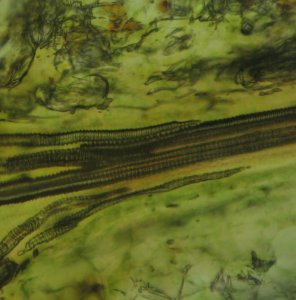
In the case of the watercress leaf veins, its veins are flexible enough to
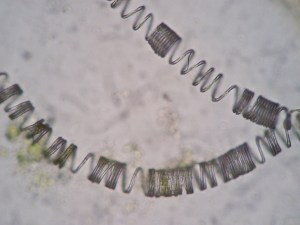
be manually pulledout into spring like coils, which is visible with low magnification (i.e. 100X.)
[Figure 2. Unraveled Spring Like Coils of Watercress (100X)]

[Figure 3. Vein CoilsExpanded by Pulling (400x)]
In other leaves like that of spinach, the veins are too rigid to be pull out into a spring like coil. The main vein near the stem of the leaf is formed by a bundle of smaller individual coiled vein tubes. As the main vein progresses towards thetip of the leaf, individual coiled vein tubes branch away from the main vein bundle.
[Figure 4. Main Vein Bundle Branching Off]

In the case of the watercress, these small-branched veins
form ring like formations further away from the main vein bundle. Veins exhibit two types of coil spacing. One type of veins has tight coils with little spacing between the spiral windings of the coils. The other type has relatively large spacing between the spiral coil windings. Under high magnification (i.e. 400X), the space between the spiral coil windings is filled with a thin sheathing.
[Figure 5. Vein Coil with Sheathing (400X)]

When the watercress vein is pull out to unravel the coil, the thin sheathing tends to break off, although sometimes some fragments of the sheathing still attach to the unraveled coil. The end of the vein coil can form into a pointed spiral tip. Sometimes water in the small veins can be seen draining rapidly out of the vein. The drained small veins form bubbles in the veins, which appear darker under the microscope.
The veins in the meat of the watermelon show coiled spiral structures similar to leaf veins.
[Figure 6. Watermelon Meat Veins with Spiral Markings (400X)]

Discussion:
Leaf veins, and fruit veins appear to be constructed of coils that have thin sheaths covering the spaces between coil windings. Similar sheath covered coils are used in the engineering world for flexible ducting. For example, a portable inside the room air conditioner uses such slinky ® like ducting to connect the hot air exhaust to the window.
[Figure 7. Man-made Coiled Duct]

The duct can be compressed into a short length during shipment, and pulled to many times its compressed length for use. It is flexible. It is very light in weight, and yet fairly strong in maintaining its tubular shape. Relatively little material is used to construct such a tube, as compared to a solid pipe, or duct. It is easy to make using linear wire coils. These advantageous characteristics of linearity, of lightweight, of strength to maintain tube shape, of flexibility, of variability of coil winding spacing, and expandability are utilized by the plant in its need to overcome gravity. Different plants may be using varying degrees of these vein coil characteristics to shape its particular needs. It is to be determined how if any of these coil properties can effect the physical shape of the plant such as whether coil rigidity effects the branching angle. While all plants utilize the coil structure for their leaf veins, whether animal blood vessels also utilize coil structuresremains to be determined.
 Golf Science Guru